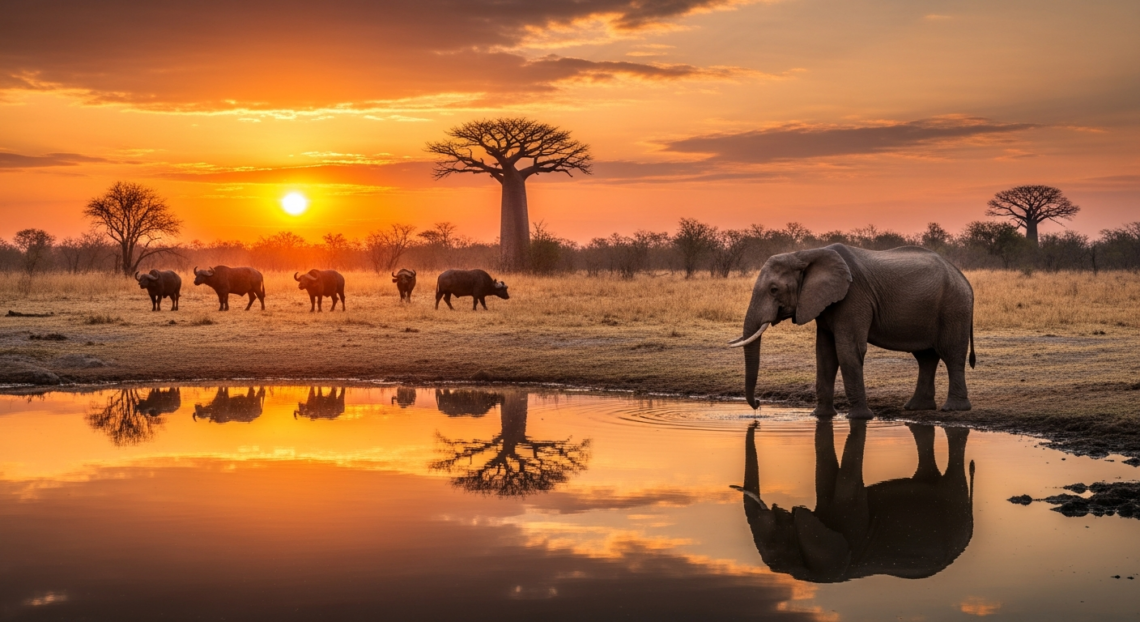
South Africa stands alone as the world’s most decorated safari destination, claiming 12 parks in the top 50 of the 2026 Best African Safari Parks list by SafariBookings — more than any other nation on the continent. From leopards draped across acacia branches in Sabi Sands to thundering elephant herds in Addo, a South Africa safari delivers wildlife encounters that’ll stay with you for a lifetime.
Key Takeaways
- South Africa dominates global safari rankings, with Sabi Sands Game Reserve ranking #4 in the world for Big 5 sightings and luxury lodges.
- The best time to visit is June through September, when dry conditions concentrate wildlife around waterholes for prime game viewing.
- Malaria-free reserves like Madikwe and Addo are ideal alternatives for families, without sacrificing quality wildlife encounters.
- Luxury lodge rates now exceed USD 5,000 per person per night, but mid-range options from USD 800 offer incredible value for budget-conscious travelers.
- Booking 12 to 18 months in advance is essential for securing peak-season availability at South Africa’s top-ranked reserves.
Why South Africa Leads the African Safari Scene
Imagine waking before dawn in Sabi Sands, coffee in hand on a lodge veranda, as a leopard melts into the golden grass just beyond the fence line. That’s South Africa’s safari magic — raw, intimate, and utterly unforgettable. No other country on the continent comes close to matching its depth of safari options, and the numbers back that up.
According to SafariBookings, South Africa claims 12 parks in the top 50 of the 2026 Best African Safari Parks list, based on 2,665 expert and traveler reviews. That’s more than any other African nation. Sabi Sands Game Reserve ranks an impressive #4 globally, while Kruger National Park holds #15 — two very different safari experiences, both world-class in their own right.
The economic scale of South Africa’s safari industry is staggering. Grand View Research values the South Africa safari tourism market at USD 4.04 billion in 2023, projected to reach USD 4.20 billion in 2024. Globally, safari tourism hit USD 34.6 billion in 2023 and is growing at a 5.8% CAGR toward USD 51.5 billion by 2030, with Africa commanding 50% of that market share. South Africa welcomed 1.8 million intra-African tourists in early 2024 alone — a 74.5% year-over-year increase that signals just how much momentum this destination has.
The Best Safari Parks and Game Reserves in South Africa
Choosing where to go is honestly one of the most exciting parts of planning a South Africa safari. Each reserve has its own personality, wildlife density, and atmosphere. Here’s a look at how South Africa’s top parks rank in the 2026 Best African Safari Parks list by SafariBookings:
- Sabi Sands Game Reserve (#4): Adjacent to Kruger, offering unrivaled leopard and lion sightings alongside world-class luxury lodges.
- Kapama Private Game Reserve (#14): Big 5 territory with excellent guided game drives and a range of lodge options.
- Kruger National Park (#15): A massive 19,485 km² wilderness offering self-drive options and a huge diversity of wildlife.
- Timbavati Nature Reserve (#19): Famous for its rare white lions and a genuinely remote, unspoiled wilderness feel.
- Madikwe Game Reserve (#20): Malaria-free Big 5 territory, making it one of the best family safari destinations in the country.
- Balule Nature Reserve (#22): Open borders with Kruger allow animals to roam freely across a vast unfenced ecosystem.
- Sabi Sabi Private Game Reserve (#23): Luxury lodges and exceptional Big 5 sightings in the Greater Kruger area.
- Addo Elephant National Park (#28): Malaria-free and home to one of Africa’s densest elephant populations — a firm family favorite.
- Manyeleti Game Reserve (#34): Gloriously uncrowded, offering an exclusive and peaceful alternative to busier reserves.
- Hluhluwe-iMfolozi Park (#35): A conservation success story, particularly celebrated for its pioneering rhino protection efforts.
- Pilanesberg Game Reserve (#48): Malaria-free and just a short drive from Johannesburg — perfect for a short break.
- Karoo National Park (#49): A unique semi-arid landscape unlike anything else on this list, with its own distinctive charm.
If you’re after unparalleled big cat sightings, Sabi Sands is the clear frontrunner. Its unfenced border with Kruger means animals move freely, and resident leopards are spotted with a frequency that’s almost hard to believe. Families should give serious consideration to Addo Elephant National Park or Madikwe Game Reserve — both are completely malaria-free, which removes a significant logistical concern when traveling with children. Book peak season, which runs from June through September, well in advance, as rising visitor numbers mean top-ranked reserves fill up fast.
Where to Stay: Luxury Safari Lodges and Camps
South Africa’s safari accommodation scene has undergone a dramatic transformation. Premier safari camps now exceed USD 5,000 per person per night in 2026, up a staggering 75% from 2019 levels when rates sat under USD 2,000. That said, the experience has evolved to match the price tag — smaller camp sizes, hyper-personalized service, and deeper conservation integration make these stays genuinely extraordinary.
The safari camp sector is growing at a 6.9% CAGR, driven by operators including Wilderness, Singita, &Beyond, and Abercrombie & Kent. Here are three standout properties worth considering for your trip:
- Singita Sabi Sand (Sabi Sands): Ultra-luxury private villas with Big 5 views from your own deck, starting from USD 3,500 per person per night.
- Thabamati Luxury Tented Camp (Kruger): Riverside tented suites with a strong conservation focus, ranging from USD 1,200 per person per night.
- Madikwe Hills (Madikwe): Family suites, wellness spas, and a malaria-free setting, starting from USD 1,800 per person per night.
Wake to hippo grunts at Singita, sipping coffee as lions prowl beyond the deck — it’s the kind of morning that redefines your relationship with nature. If ultra-luxury isn’t in the budget, don’t worry. Mid-range camps offer genuinely impressive experiences in the USD 800 to USD 1,500 per person per night range, with excellent guiding and comfortable accommodation. Top operators allocate approximately 30% of their revenue to conservation initiatives, meaning your stay directly funds wildlife protection. You can explore more about what a luxury South Africa safari truly looks and feels like to help narrow down your choices.
Safari Activities and Experiences You Won’t Forget
A South Africa safari is far more than sitting in a game vehicle hoping something walks past. The range of immersive activities on offer is genuinely impressive, and you can shape an itinerary that suits your pace and interests perfectly.
Here are some of the standout experiences to put on your radar:
- Dawn and dusk game drives in Sabi Sands: Expert rangers guide you through 4×4 drives during the golden hours, when leopards drape from trees and predators are most active.
- Guided bush walks in Madikwe: Track elephant spoor on foot and experience the African bush at a slower, more intimate pace.
- Hot-air balloon safaris over Kruger: Float above the savanna for aerial Big 5 views at approximately USD 450 per person — one of the most spectacular ways to experience Kruger.
- Wildlife photography sessions: Most lodges offer specialist photography guides for early-morning light sessions.
- Stargazing in remote reserves: Away from light pollution, the night skies in places like Manyeleti are nothing short of spectacular.
One of the most exciting trends shaping safaris right now is the “slow safari” movement. According to Next Adventure, 2026 is seeing a growing shift toward longer stays focused on bush walks, stargazing, and deeper nature immersion rather than back-to-back high-volume game drives. It’s a refreshing approach that lets you truly settle into the rhythm of the bush. Golden-hour drives reveal rhinos silhouetted against fiery Kruger sunsets — those moments of stillness are what slow safaris are all about. Millennials are leading this charge, accounting for 37% of friend-group safari bookings according to Safari.com, while group travel in general is growing at a 6.4% CAGR. Always choose ethical operators who prioritize minimal wildlife disturbance and no-crowd sightings.
When to Go and How to Plan Your South Africa Safari
Timing your safari well makes an enormous difference to what you’ll see. The peak dry season runs from June through September, and it’s widely considered the best window for wildlife viewing. Vegetation thins dramatically, animals concentrate around shrinking waterholes, and predator sightings increase as a result. Avoid the summer rainy season if possible — dense foliage reduces visibility, and road conditions in some reserves can deteriorate quickly.
Here’s a practical planning checklist to help you get ready:
- Pack neutral-colored clothing (khakis and olive tones), a good pair of binoculars, and malaria prophylaxis if you’re heading to areas like Kruger or Sabi Sands.
- Budget between USD 500 and USD 5,000 per person per night depending on your lodge tier, and factor in round-trip flights from the US averaging approximately USD 1,500.
- Book 12 to 18 months in advance for 2026 peak-season availability, especially at top-ranked reserves where demand is outpacing supply.
- South Africa offers visa-free entry for many nationalities, which simplifies planning considerably — check your country’s specific requirements before booking.
- Download offline maps for remote reserve areas where cell coverage can be unreliable.
For families specifically, the malaria-free trio of Addo, Madikwe, and Pilanesberg removes a significant health consideration without compromising on Big 5 wildlife encounters. Solo travelers and friend groups increasingly favor places like Sabi Sands and Kruger for a more immersive, remote wilderness experience. Whatever your travel style, there’s a South African safari that fits it perfectly.
Safari Trends and What to Expect in 2026 and Beyond
Africa’s tourism recovery has reached an impressive 96% of pre-pandemic levels, with strong momentum carrying into 2026 and beyond. According to the IMARC Group, global safari tourism is projected to reach USD 55.3 billion by 2033 at a 5.06% CAGR, up from USD 34.6 billion in 2023 — and South Africa is positioned to capture a significant share of that growth.
Several key trends are reshaping what a South Africa safari looks and feels like right now:
- Rate increases of 75% since 2019 are being justified by enhanced exclusivity, dramatically smaller camp sizes, and premium, personalized experiences.
- Multi-generational and family travel suites are in high demand, with lodges like Madikwe Hills leading the charge with interconnected family accommodation.
- Wellness-integrated safari experiences — think spa treatments, yoga decks overlooking the bush, and mindfulness sessions in the wilderness — are booming across premium properties.
- Conservation-focused operators are gaining significant market share as habitat pressures grow and travelers increasingly choose lodges that actively fund wildlife protection.
What’s particularly encouraging is that demand has remained remarkably resilient despite higher rates. The luxury safari market has shown itself to be largely insulated from typical price sensitivity — travelers who prioritize this kind of experience are willing to invest in doing it properly. As Safari.com notes, the future of African safaris is being shaped by travelers who want meaning, not just sightings. South Africa, with its unmatched park diversity, world-class lodges, and deeply embedded conservation culture, is perfectly placed to deliver exactly that.
*This article was thoughtfully created with help from Perplexity and Claude for research and drafting then carefully reviewed and edited by a person to ensure it’s accurate and helpful. Some links are affiliate links, which means we may earn a small commission—at no extra cost to you—if you choose to make a purchase.*
Sources:
The South African – Twelve SA parks feature in 2026 Best African Safari Parks list
Grand View Research – Safari Tourism Market Size, Share & Trends Report, 2030
Next Adventure – Safari Travel Trends into 2026
IMARC Group – Safari Tourism Market Size, Share, Trends, Report 2025–33
Safari.com – The Future of African Safaris: Top Travel Trends for 2025